
Finding and Stopping Common Roof Leaks
Most roof leaks start in a handful of predictable places. Here's where to look, what you can check yourself, and when to call someone.
Justin Shirley · CEO, State Roofing & Exteriors · President, RCAW
7 min read
Published
The short version
- ✓Water travels. The stain on your ceiling is often feet away from where the roof is actually leaking.
- ✓Most leaks start where something breaks the roof surface: pipe boots, flashing, chimneys, skylights and valleys.
- ✓A one-time leak at a failed part is an everyday repair. A leak that keeps coming back usually points to a bigger problem.
- ✓In a storm, protect the inside first. Save the roof work for a dry day.
A roof rarely leaks in the middle of a healthy field of shingles. It leaks where the roof changes direction, meets a wall, or has something poking through it. Knowing where to look saves time and money.
First, protect the inside
- ✓Move belongings and set out buckets or towels.
- ✓If a ceiling is sagging with water, keep people away from it and turn off power to any light fixtures in that area.
- ✓Take photos of the damage inside and out, with dates. You may need them for insurance.
- ✓If water is coming in fast, call a roofer for an emergency tarp. Don't climb onto a wet roof yourself.
Remember that water travels
Water can run along the underside of the roof deck or a rafter before it drips, so the ceiling stain is a clue, not the answer.
On a dry day after rain, look in the attic with a flashlight. Check for dark stains on the decking, wet or matted insulation, rusty nails, and spots where you can see daylight. Then trace the trail uphill.
The usual suspects
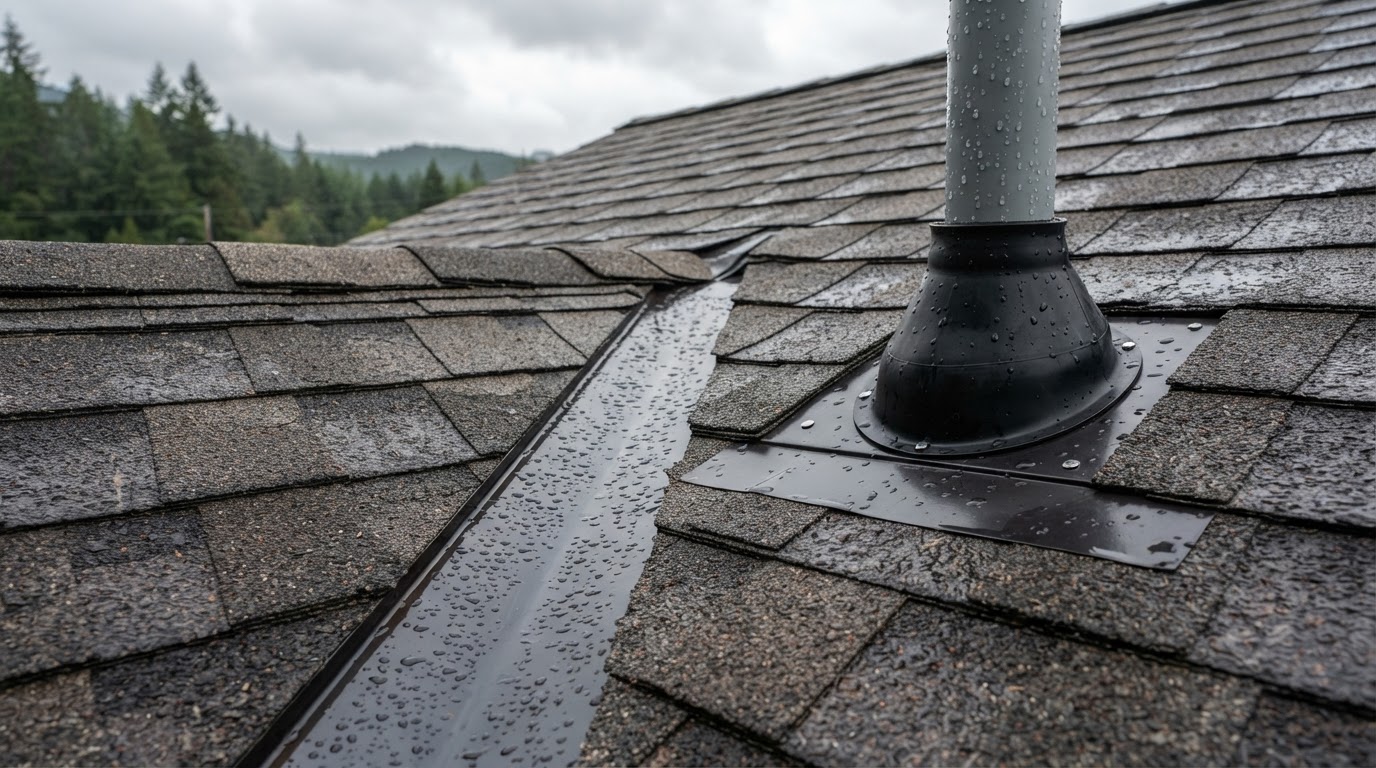
- 1Pipe boots. The rubber collar around plumbing vents cracks with sun and age. It's one of the most common leaks there is, and usually a simple repair.
- 2Walls and step flashing. Where a roof meets a wall, metal flashing has to be woven in with the shingles and tucked behind the siding. Missing kickout flashing at the bottom of a wall can send water behind the siding instead of into the gutter.
- 3Chimneys. Flashing, counterflashing and the mortar joints all have to hold. Wide chimneys often need a small cricket behind them to steer water around.
- 4Skylights. Failed flashing or seals. Note that drips on a cold morning can be condensation on the glass rather than a leak.
- 5Valleys. They carry the most water on the roof, so worn shingles, debris and moss there show up fast.
- 6Wind damage. Lifted or missing shingles after a windstorm, often along edges and ridges.
- 7Overflowing gutters. Clogged gutters can back water up under the roof edge.
Is it really a leak?
In winter, water in the attic can come from condensation rather than rain: warm, moist air from the house hits the cold roof deck. Frost on nail tips or damp decking on a dry, cold day is a ventilation problem, not a roof hole. See the attic ventilation guide.
A repair, or something bigger?
A single leak at a failed pipe boot or a piece of flashing is an everyday repair. Be more cautious when leaks keep coming back in the same spot, show up in more than one room, or appear on an older roof with worn shingles. That usually means the underlayment or the roof as a whole is near the end. The Repair or Replace guide walks through that decision.
What not to do
- ✓Don't rely on a tube of roofing caulk or tar. It can hide the real problem and trap water.
- ✓Don't climb onto a wet or steep roof.
- ✓Don't ignore a small stain. Small leaks rot decking quietly.
Justin's rule of thumb
Caulk is a patch, not a fix. If someone's whole repair is a tube of sealant, ask what failed and why.
Getting quotes for a repair?
Hold every bid up to the free Roof Estimate Checklist.
Common questions
Where do most roof leaks start?
Where something breaks the roof surface: pipe boots, step flashing at walls, chimneys, skylights and valleys. Wind-lifted shingles and overflowing gutters are also common causes.
Why is the ceiling stain not where the roof is leaking?
Water often runs along the underside of the roof deck or a rafter before it drips, so the stain can be feet away from the actual leak. Check the attic on a dry day after rain and trace the trail uphill.
Is water in the attic always a roof leak?
Not always. In winter, warm, moist air from the house can condense on the cold roof deck. Frost on nail tips points to a ventilation problem rather than a hole in the roof.

Justin Shirley
Justin Shirley is CEO of State Roofing & Exteriors and President of the Roofing Contractors Association of Washington (RCAW).
More about Justin